

Industrial traceability and et products genealogy
Containers and transfers modeling, systematic traceability of material flows
detailed genealogy of batches and used equipments
In order to guarantee the quality of their products and comply with increasingly demanding legislation, industries must have now an effective product traceability.
what does industrial traceability involve?
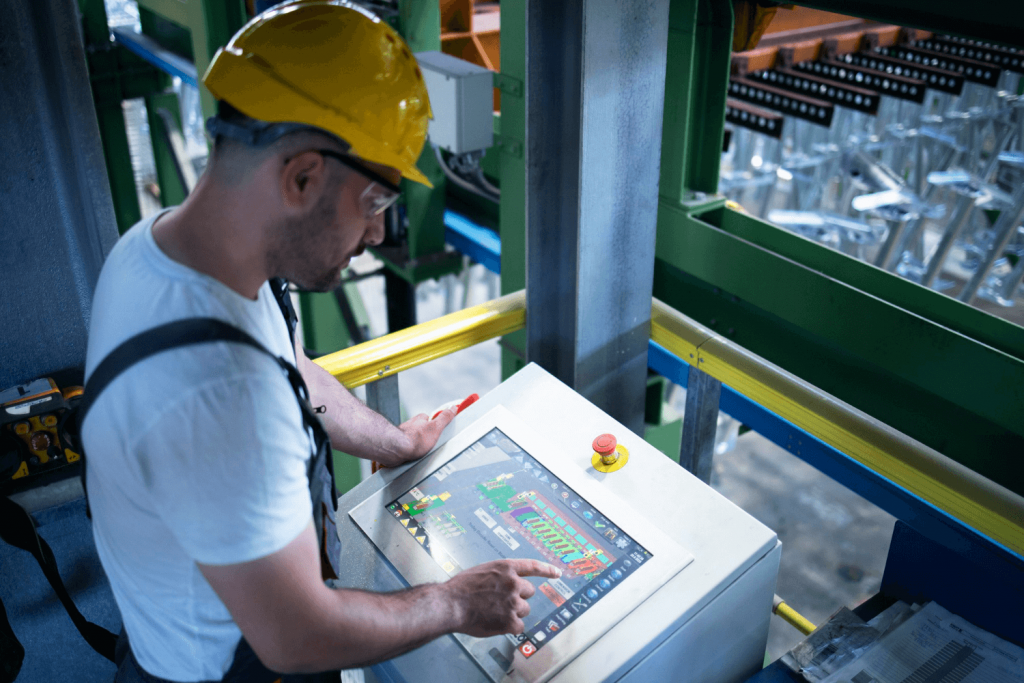
Immediately identifying the batches of material that make up a finished product, or the products that use a component in question, is now an essential asset. Industrial traceability (material traceability or product traceability), sometimes also referred to as material genealogy or material flow tracking, consists of tracing the transfer of materials within a facility by recording all the attributes associated with these materials and any transformations they may undergo through assembly, mixing, or chemical reaction.
These attributes include the type of material (raw material, intermediate material, product), categories (powders, liquids, metals, etc.), properties (density, hygrometry, etc.), supplier batch, quantity, etc.
Definition of ascending industrial traceability
Industrial traceability, also known as tracing, allows you to trace a finished product back to the raw materials used in its manufacture. This industrial traceability is therefore very useful in the event of a problem with a product, reported by a consumer for example, to identify the causes of a defective product and remedy it as quickly as possible.
Regulations surrounding industrial traceability
When we talk about industrial traceability, we immediately think of the food sector, which is required by Regulation (EC) No. 178/2002 to ensure upstream and downstream traceability of foodstuffs. This must be established at all stages of production, processing, and distribution.
But in reality, traceability regulations apply to all industries, including pharmaceuticals, automotive, minerals and glass, metal, plastics, wood, paper and cardboard, and aeronautics.
Definition of descending industrial traceability
Industrial traceability, also known as tracking, allows raw materials to be traced back to the finished products that were manufactured using them, and makes it possible to know where and to whom these products were delivered.
In the event of a problem, this industrial traceability makes it possible to quickly identify and recall all products that have been affected by an anomaly.
We will not list all the standards that exist in terms of industrial traceability here, but will simply remind you of the laws and regulations relating to traceability that apply to all industries:
- ISO 9000: defines traceability as the ability to trace the history, application, use, and location of an item or its characteristics using recorded identification data.
- ISO 9001: an international standard aimed at improving business profits by providing a set of rules applicable to manufacturing processes, products, and the entire supply chain. Inefficient procedures and repeated errors are eliminated, ensuring credibility for the company and customer satisfaction.
Why use traceability software?
Nowadays, having flawless traceability is essential.
Due to increasingly stringent regulations, manufacturers must be able to demonstrate at any time that their products comply with current regulations, or react quickly in the event of a product failure in order to remove them from the market immediately.
Industrial traceability software provides manufacturers with all the information they need in real time to control the quality of their products and ensure that all stages of manufacturing have been carried out in compliance with legislation. Finally, industrial traceability software provides consumers with a guarantee of safety and quality.
Key features provided by the traceability module of the COOX MES software
Upstream and downstream traceability of batches
Particularly important in the food and pharmaceutical industries, product genealogy, or upstream genealogy, allows you to use a batch of finished product to identify the batches of raw materials or components used in its manufacture, as well as all their attributes (supplier, physical and chemical characteristics, etc.). Raw material genealogy, or downward genealogy, allows you to trace a batch of raw materials back to all the batches of finished products in which it was used, enabling you to block the affected batches or immediately identify them for withdrawal in the event of a problem with a raw material.
Based on the unique concept of “Produce, it’s traced!”, the MESbox MTG module of the COOX Origin MES software enables native, systematic tracking of material flows within a facility by modeling all equipment containing material (containers), transfers between them, and the operations that take place there (stacking, mixing, processing). Among other things, it provides real-time information on workshop stocks and their location, and enables the upward and downward genealogy of products to be traced.
If a quality control check reveals a defect in a raw material, the question is to know which manufactured products have used this supply batch. This is “downstream” genealogy. Conversely, if an anomaly is detected in a batch of delivered products, an “upstream” trace will be required to highlight any possible manufacturing anomalies (defective raw material, inadequate mixing temperature, cycle times not respected, etc.).
The MESbox MTG pack of the COOX Origin MES software includes specialized components that can answer these questions without specific development and provide an immediate response to the user.
Modeling containers and transfers – Physical paths within the facility
The MESbox MTG pack of the COOX Origin MES software reconstructs the path of raw material and product batches within your facility in real time, using simple container and transfer concepts, as well as a graphical description of the physical links between the elements of the facility (topology). All you need to do is tell the system which equipment is used to contain materials and which operations involve processing or transferring materials, and it will automatically locate the products in the facility and immediately reconstruct their path with timestamps and batch identification. The model is applicable to any technology for identifying batches of raw materials or products (barcode, DataMatrix, RFID, etc.).
Equipment used by a batch
The MESbox MTG pack provides immediate access to the list of equipment used by a batch. The search can be performed downstream (raw material batch) or upstream (finished product batch).
Here again, a detailed mode is available, providing a detailed understanding of the route taken within the facility. It should be noted that, if this setting is selected, the genealogy manages the storage in a container device of the passage of a contaminant until the cleanliness of the equipment has been explicitly validated.
Note that genealogy, if this setting is selected, manages the storage in a container device of the passage of a contaminating material until the cleanliness of the equipment is explicitly validated.
Detailed genealogy – Lot tracking
If the result obtained by a lot’s genealogy seems abnormal, you have access to a detailed mode that reconstructs the entire path in a tree structure, for example, from a raw material in question to the final product. Each processing or transfer operation is identified, with the date and time, the quantity of material involved, and the source and destination equipment. The complete tracking is provided, even if different names and lot numbers are assigned to intermediate materials. This information is stored in a database and can be viewed and archived over long periods of time.

CORRESPONDING MODULES FROM THE COOX® RANGE
Product traceability and genealogy are fully supported by the MESbox MTG (Material Tracking & Genealogy) module from the COOX range.
It enables the rapid implementation of immediate, high-level product traceability that meets current requirements and anticipates future developments. It can be combined with other packs in the COOX range, in particular the MESbox SCADA (supervision) and PMT (manufacturing execution) modules, to build a complete workshop monitoring solution.
- Upstream and downstream product traceability (genealogy)
- Automatic traceability and presentation of results in summary or detailed form
- Modeling of containers and material transfers
- Tree view of flows
- Customizable operating ergonomics
- Monitoring of workshop stocks of raw materials and products
- Operation from any point on the intranet
- FDA 21 CFR 11 requirements